8 Family Recipe Journal Pages Worth Making and Keeping
A family recipe journal is most valuable when it preserves the person, occasion and small habits around the food—not only the ingredient list. These eight page formats make room for both usable instructions and family memory.
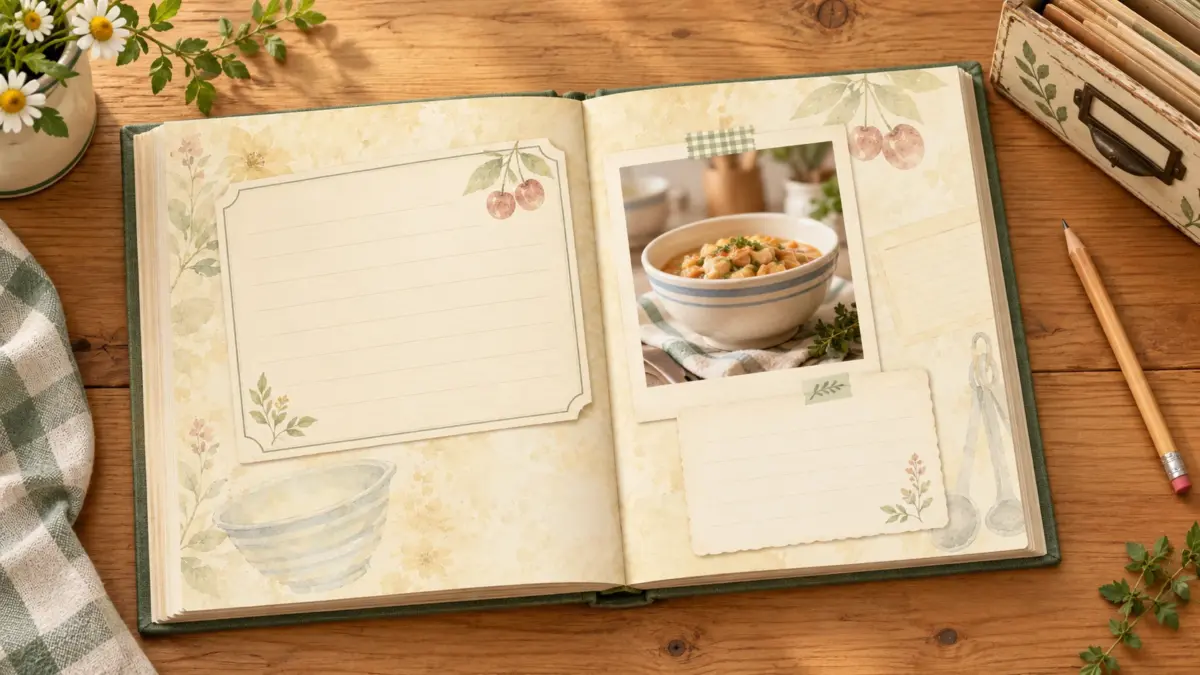
Featured image note: This AI-generated two-page journal mockup is illustrative; its cards, food photo and props are for inspiration only, not included files or a tested US Letter layout.
Start with recipes your household still cooks or talks about. Photograph the original card before handling it, transcribe uncertain measurements honestly, and leave a notes area for variations instead of silently “correcting” a relative’s method.
At a glance
- The original card and clean copy: Show a photograph of the handwritten card beside a readable transcription.
- Who taught whom: Add a small family line connecting the cook who shared the recipe to the people who make it now.
- The holiday table: Pair the recipe with one photograph of the occasion it belongs to.
Before you start
Gather recipe cards, kitchen photographs, menus and names of relatives who can verify details. Use wipeable sleeves for pages that will sit near food. US Letter pages give long recipes enough room; a 6 × 8-inch format works for shorter cards and one photograph.
1. The original card and clean copy
Show a photograph of the handwritten card beside a readable transcription. Preserve crossed-out words and unusual phrasing in the image.
Before copying the recipe, decide what belongs on the clean version and what should stay visible only in the original-card photo. Mark hard-to-read words or measurements as uncertain, and note the pan size or serving count only when the card or a family source confirms it.
If you’re building a keepsake around one inherited recipe, our Grandma’s recipe cookbook guide explains how to keep a card copy, transcription, family story, cooking notes, and dated changes easy for relatives to follow.
2. Who taught whom
Add a small family line connecting the cook who shared the recipe to the people who make it now. Confirm names and relationships before printing.
For the family line, write the names as you know them and connect each person to a specific role: who shared the recipe, who taught it, and who makes it now. Add a year only if someone or a dated source can confirm it; leave a question mark in your notes when a link still needs checking.

3. The holiday table
Pair the recipe with one photograph of the occasion it belongs to. Record the year and the people present rather than relying on memory later.
Make the holiday photograph carry a useful caption: the year, the dish on the table, and the people you can identify. Add one detail that places the meal in its setting—such as which dish was served first or where the recipe card sat—without guessing at anyone’s name or memory.
One US Letter layout for a Thanksgiving recipe
For a single dish worth remembering, pair a short recipe block with a table photo and a note about who shared it. Page 2 of the optional Free November Harvest Gratitude sample has sage-and-cream stripes for a small seasonal accent. For a kitchen-themed look, try the existing Grandmas Recipe Family Cookbook sample instead.
On an 8.5 × 11-inch US Letter sheet, sketch a 7.5-inch square composition:
- Center a 6 × 4-inch recipe card at the top.
- Place a 4 × 3-inch photo and a 3 × 3-inch memory card in the lower row, with a 0.5-inch gap between them.
- Leave another 0.5-inch gap between the top card and lower row. Together, the rectangles make a 7.5 × 7.5-inch composition, leaving 0.5 inch at each side when centered.
Check the printer’s printable margins and preview before trimming or placing pieces; allow extra space if binding holes will take part of the page.
Use the 6 × 4 card for the dish name, who shared it, ingredients and a short method. If the full method will not stay readable, keep the original recipe on a separate card and use this layout for the source, date, table photo and one memory note. Preserve uncertain wording rather than silently changing it.
This is a proposed arrangement based on the sample artwork, not a tested template or a ScrapBujo print test. The sample paper is square, so keep its proportions when printing or trimming; printer margins and output size vary by setup.
4. A page for substitutions
Create a dated log for ingredient swaps, dietary changes and pan sizes. Keep the original recipe untouched above the experiment notes.
Give each version its own dated line: ingredient changed, amount used, pan size, and what happened to the result. Keep the family’s original wording intact, then write the substitution beside it so the next cook can tell which instructions came later.

5. The sensory memory
Use this space for what the cook remembers: the smell when the lid lifted, the sound of a spoon against the bowl, or the texture noticed at the table. Name whose memory it is and, if useful, when it was written down. These details can help a family remember a meal, but they are personal recollections, not cooking checks.
Keep the original family recipe in its own wording, and place any current method, timing, temperature or resting instructions in a separate, clearly labeled cooking note. Do not change the inherited recipe to make a memory fit. When a cooking question needs checking, consult current food-specific guidance from FoodSafety.gov or Health Canada.
6. Tools from the kitchen
Photograph a familiar bowl, spoon, tin or apron connected with the recipe. A single object can carry more emotional weight than decorative clipart.
Name the step each tool helps with—measuring, mixing, scraping or serving—and note who used it only when that detail is known. This gives the next cook practical context alongside the object photograph without inventing its history.

7. The failed batch story
Record one honest mishap and what fixed it. Practical mistakes make the journal useful and bring the family voice into the instructions.
For a failed-batch note, record what changed from the last successful version, what you noticed, and what adjustment helped on the next try. Keep it in the cook’s own words when possible; one specific observation is more useful than a polished story with details no one can verify.
8. Pass-it-on page
End with a blank note area for the next cook. Include space for a name and date so the recipe can continue to collect history.
Leave the next cook a short handoff: who last made the dish, when, and one question or change they may want to try. Keep a separate blank line for the next name and date so a future note does not overwrite the original recipe or earlier versions.


What to avoid
Avoid covering the main photograph, shrinking journaling until it is uncomfortable to read, or using every pattern simply because it belongs to the same kit. Do not invent dates, quotations, print results or family details to make a page feel finished. Mark uncertain information honestly and protect addresses, children’s identifying details and private messages before publishing images online.
How to start today
Choose one idea from this guide, one photograph or writing prompt, and two coordinating papers. Make a loose arrangement without adhesive, write the factual caption, then decide whether the page needs anything else. One completed, readable page is a better beginning than twelve elaborate bases waiting for the “perfect” memory.
Try the style before choosing the full collection
Open Free Grandmas Recipe Family Cookbook – 3 Printable Scrapbook Paper Samples to examine a free ScrapBujo sample first. The sample page explains the included files and usage terms and links back to the matching collection when one is available.
Check size before you print
Use the 300 DPI to pixels calculator to confirm the pixel dimensions for your finished size. For full-size square layouts, the 12×12 scrapbook printing guide explains wide-format printers, print services, paper support and true-size settings.
See the quick visual Story for this guide.
Explore Grandmas Recipe Family Cookbook on ScrapBujo for the coordinated previews and file details.
View this digital collection on Etsy. This is a digital download; no physical paper is shipped.
Source note: The collection facts and preview images in this article were checked against the ScrapBujo catalog on 2026-10-09. The examples are product previews; they do not replace a print test.
Explore ScrapBujo digital collections
Explore the related digital collection
Review the collection previews and current file details before choosing a format.

12×12 in 300 DPI Digital download
Digital Scrapbook Papers
Grandmas Recipe Family Cookbook
Explore the Grandmas Recipe Family Cookbook digital scrapbook paper collection: 28 square 12…
Each product page identifies its checkout, current price, and digital delivery details.